
March Is Colon Cancer Awareness Month – Please Don’t Ignore the Signs
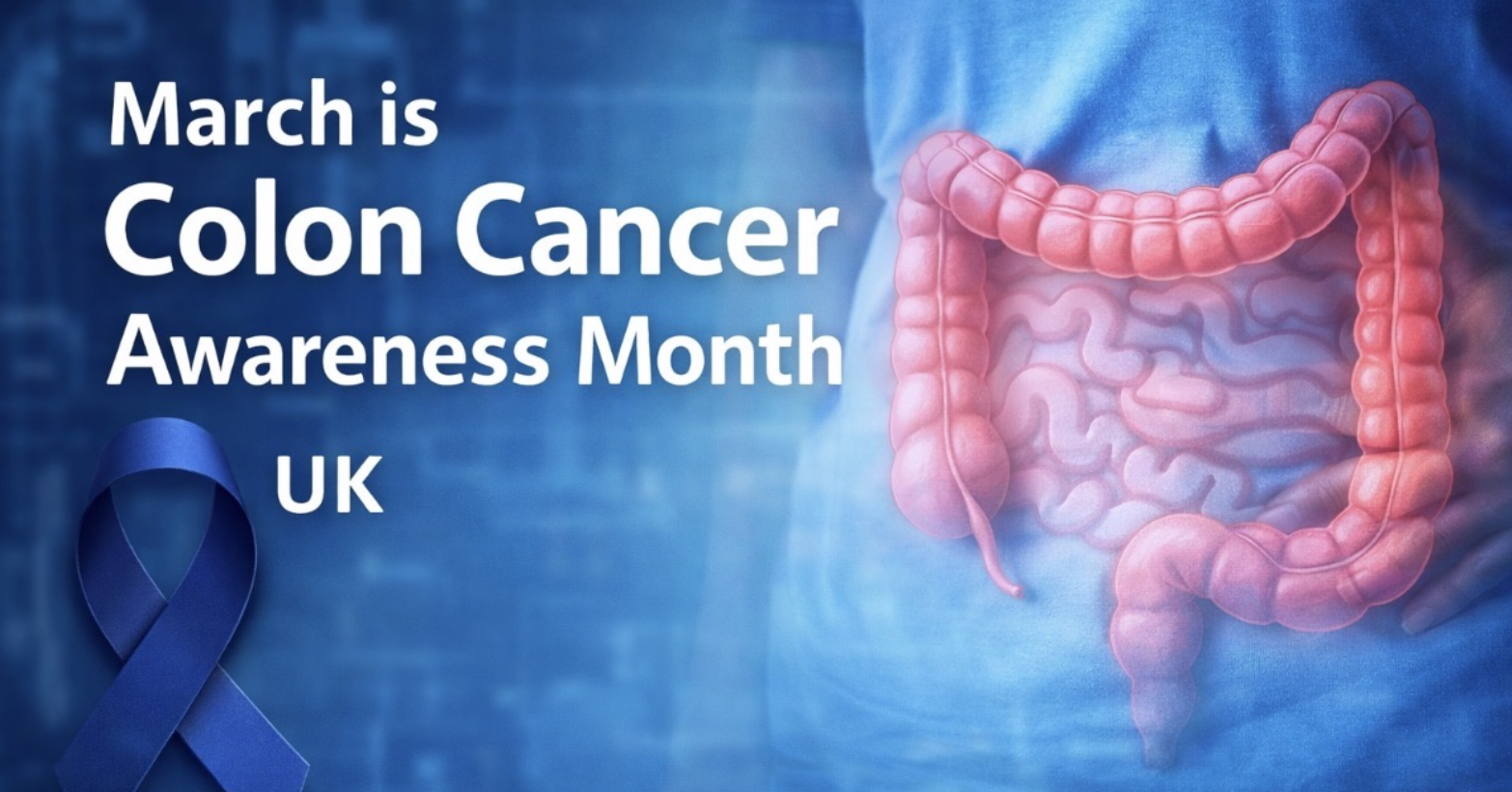
March is Colon Cancer Awareness Month, and this is one that feels personal to me. It is something I discuss frequently in clinic, and increasingly, something I am seeing in younger patients in everyday practice.
Bowel cancer remains the fourth most common cancer in the UK, with around 42,000 new cases diagnosed each year (1). Yet despite national screening programmes and improved awareness, many cases are still diagnosed at a later stage. Organisations such as Bowel Cancer UK continue to do outstanding work raising awareness, supporting patients, and campaigning for earlier diagnosis.
The uncomfortable truth is this: early detection dramatically improves outcomes — but only if people come forward.
The Changing Landscape
Traditionally, bowel cancer was considered a disease of older adults. Screening in England now begins at age 50, using the Faecal Immunochemical Test (FIT), a simple home stool test that detects hidden blood (2).
However, both UK and international data show a gradual increase in incidence among adults under 50 (1). This trend mirrors findings across Europe and the United States.
Half of cases are still diagnosed at stage 3 or 4 (1). That matters — because stage at diagnosis remains one of the strongest predictors of survival.
In primary care, this shift means we must maintain a lower threshold for investigation, particularly when symptoms persist or do not follow a benign pattern.
Symptoms Not to Ignore
Many symptoms of bowel cancer are non-specific and easily attributed to lifestyle or stress. That is precisely why they are missed.
Key symptoms include (3):
Persistent change in bowel habit (looser stools, constipation, or increased frequency)
Blood in the stool (bright red or darker/mixed in)
Unexplained iron deficiency anaemia
Ongoing abdominal pain or bloating
Unintentional weight loss
Unexplained fatigue
Importantly, these do not automatically mean cancer — but they do warrant assessment.
If symptoms persist beyond three weeks, or feel different from your usual baseline, speak to your GP.
What Happens If You See Your GP?
The first step is usually straightforward.
For many patients, this involves:
A FIT stool test (simple home kit)
Basic blood tests including FBC and ferritin
Clinical examination where appropriate
FIT has significantly improved early detection in primary care and is now central to both screening and symptomatic pathways (2). It is non-invasive and easy to complete.
If results suggest further investigation is needed, referral for colonoscopy or imaging follows under established pathways.
The key message: the first step is often simple.
Why Might Rates Be Increasing in Younger Adults?
There is unlikely to be a single explanation. The picture is complex.
We know several modifiable risk factors contribute to bowel cancer risk (1,4):
Higher consumption of red and processed meat
Low fibre intake
Obesity
Physical inactivity
Alcohol
Meta-analyses suggest that each 100g/day increase in red and processed meat intake is associated with an 18% increased risk of colorectal cancer (4). Conversely, every 10g/day increase in total dietary fibre is associated with around a 9% reduction in risk (5).
UK fibre intake remains well below the recommended 30g/day (5). At the same time, dietary patterns have shifted towards more ultra-processed foods, lower wholegrain intake, and more sedentary lifestyles.
There is also growing interest in the role of the gut microbiome and inflammatory pathways, although research in this area is ongoing.
The reality is that our modern environment has changed faster than our biology.
Screening Saves Lives – But Uptake Matters
The NHS Bowel Cancer Screening Programme offers FIT testing every two years from age 50 in England (2).
Yet participation remains suboptimal, often due to embarrassment or anxiety. The irony is that this small, simple test can detect disease before symptoms even develop.
Charities such as Bowel Cancer UK provide excellent patient-friendly resources explaining both symptoms and screening in clear, accessible language.
If you receive a screening kit — complete it.
Detection Is Improving — But We Need People to Come Forward
We are better at detecting bowel cancer than ever before. FIT testing, improved referral pathways, and greater public awareness are all positive developments.
But diagnostics only work if patients present.
If you are younger and experiencing persistent symptoms, do not dismiss them on the basis of age alone. Equally, as clinicians, we must avoid premature reassurance where symptoms warrant investigation.
Early detection is not just a slogan — it is the single most powerful tool we have to improve survival.
March is a reminder. But vigilance should not be seasonal.
References
Cancer Research UK. Bowel cancer statistics. Available at: https://www.cancerresearchuk.org
NHS. Bowel cancer screening. Available at: https://www.nhs.uk/conditions/bowel-cancer-screening/
NICE. Suspected cancer: recognition and referral (NG12). 2015 (updated).
Farvid MS et al. Consumption of red and processed meat and cancer incidence: systematic review and meta-analysis. Eur J Epidemiol. 2021;36:937–951.
Oh H et al. Different dietary fibre sources and risks of colorectal cancer: dose–response meta-analysis. Br J Nutr. 2019;122(6):605–615.