
Processed Meats at Christmas: What’s the Real Risk and How Can We Reduce It?
By Dr Timothy Eden, MBBS
Registered Dietitian from Eden Health and Nutrition
Read time approx. 4mins
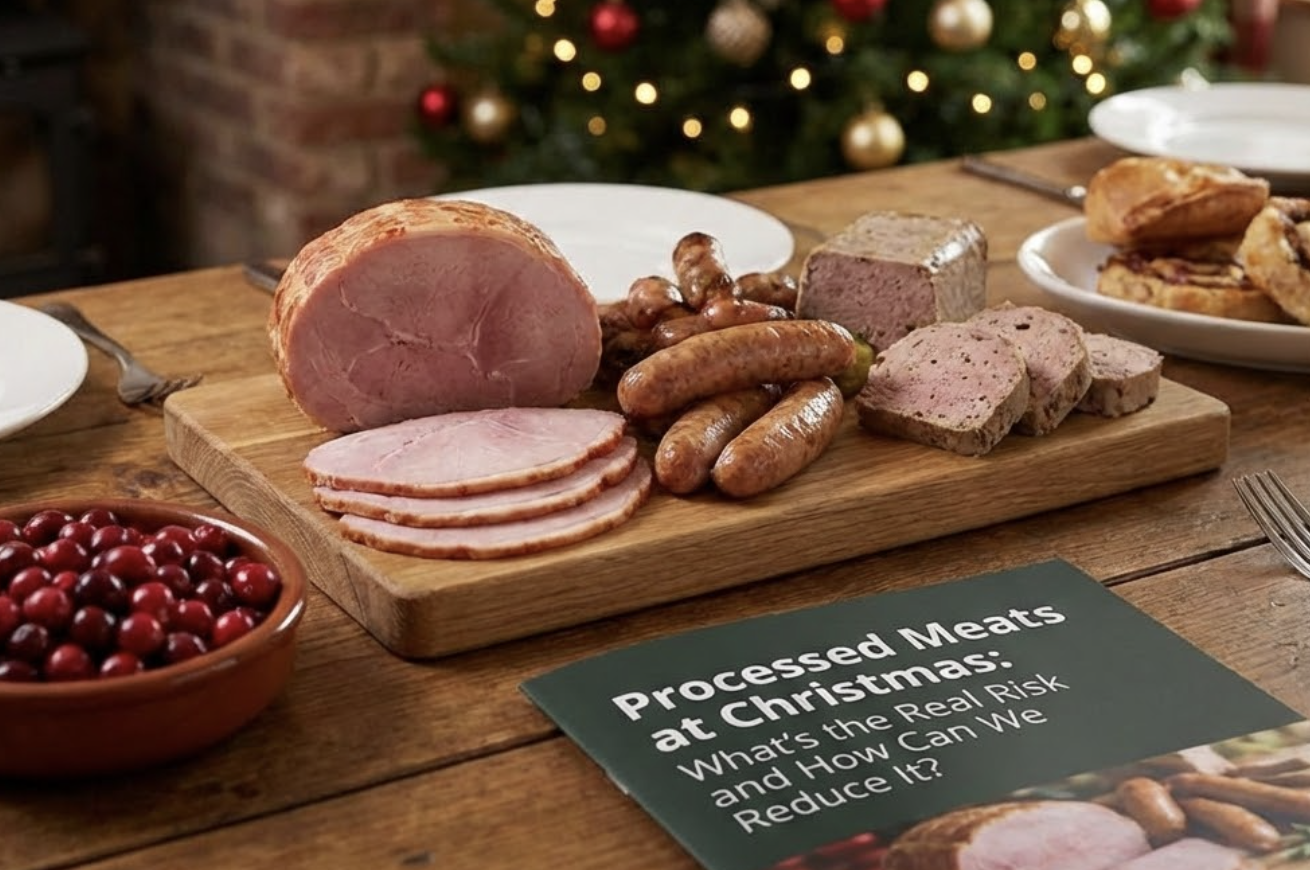
Ham at breakfast, pigs in blankets at lunch, sausage rolls at snack time — the festive season is one of the few periods of the year when processed meats can become a near-daily feature for many households. Alongside the tradition and enjoyment, however, comes an important nutritional conversation about nitrites and nitrates — substances commonly used in processed meats and consistently linked with bowel cancer risk.
This is not about fear-mongering or banning Christmas foods. It is about understanding the science, making informed choices, and reducing risk where we realistically can, in line with NHS cancer-prevention advice and NICE principles on long-term disease prevention.
What Are Nitrites and Why Are They Used?
Nitrites (and their closely related compounds, nitrates) are food additives used primarily in processed and cured meats, including:
Ham
Bacon
Sausages
Salami and pepperoni
Frankfurters and hot dogs (the ones at the Christmas markets)
Corned beef
They are used for three main reasons:
Preservation – inhibiting bacterial growth, particularly Clostridium botulinum
Colour retention – giving cured meats their characteristic pink/red appearance
Flavour enhancement – contributing to the “cured” taste profile
Nitrites themselves are not inherently toxic at the levels used in food. The problem arises after cooking and digestion, when nitrites can react with proteins and haem iron to form N-nitroso compounds (NOCs) — a class of chemicals with well-established carcinogenic potential.
Why Nitrites Matter for Bowel Health
From both a clinical and public-health perspective, the concern around processed meat centres on colorectal (bowel) cancer risk.
Large epidemiological studies repeatedly demonstrate that:
Regular processed meat intake increases bowel cancer risk
The risk rises in a dose-dependent fashion
Nitrites play a key mechanistic role in driving this association
N-nitroso compounds formed from nitrites:
Damage DNA in the cells lining the bowel
Promote chronic low-grade inflammation
Disrupt the gut microbiome
Increase abnormal cellular turnover and malignant transformation
This is why processed meat is classified as a Group 1 carcinogen by WHO International Agency for Research on Cancer — the same evidence category as tobacco smoke and asbestos. This classification does not mean the absolute risk is the same, but it does mean the evidence of causation is strong.
From a clinical standpoint and something key that I flag in clinic is to discuss processed meat reduction and reduction in ultra processed foods (UPFs) particularly important for people with:
A family history of bowel cancer
Previous bowel polyps
Inflammatory bowel disease
A personal history of colorectal cancer
How Much Is “Too Much”?
There is no fully “safe” threshold at which processed meat becomes entirely risk-free. However, cancer-risk modelling shows that even relatively small daily intakes raise lifetime risk over time.
In practical clinical terms:
Occasional intake → low individual risk
Regular daily intake → measurable increased risk
High habitual intake over decades → significantly higher lifetime risk
Christmas itself is not dangerous because of one festive meal. The risk becomes more relevant when December turns into several weeks of daily bacon, ham, sausages and deli meats, especially carried forward into the New Year.
Nitrites vs Nitrates — Is There a Difference?
This distinction is often misunderstood.
Vegetables such as beetroot, spinach, rocket and lettuce contain naturally occurring nitrates. These behave very differently in the body because they are packaged with:
Vitamin C
Polyphenols
Antioxidants
Fibre
These compounds inhibit the formation of carcinogenic nitrosamines and are associated with cardiovascular and metabolic benefits.
By contrast, nitrites added to processed meat are typically combined with:
High-temperature cooking
Haem iron
Low antioxidant protection
This creates the ideal biochemical environment for carcinogen formation. In short: nitrates in vegetables are protective; nitrites in processed meat carry risk.
How to Spot Nitrites on Food Labels
Nitrites are rarely listed in plain English. Instead, look for these additive codes “E numbers”:
E249 – Potassium nitrite
E250 – Sodium nitrite
E251 – Sodium nitrate
E252 – Potassium nitrate
If any of these appear, the product contains curing agents linked with nitrosamine formation.
Marketing terms such as:
“Traditionally cured”
“Naturally cured”
“Uncured”
can be misleading, as many products still use celery powder or beet extracts that convert into nitrites during processing. The only reliable indicator is the absence of E249–E252 on the label.
Practical Festive Swaps and Risk-Reduction Strategies
This is where realism matters most. The goal is risk reduction, not elimination.
1. Choose Nitrite-Free Where Possible
Many UK supermarkets now stock nitrite-free bacon, sausages and uncured hams clearly labelled as “No Added Nitrites or Nitrates”. These significantly reduce formation of N-nitroso compounds.
2. Reduce Frequency, Not Just Portion Size
From a cancer-risk perspective, how often you eat processed meat matters more than whether you reduce one serving slightly.
Try:
Processed meat every other day rather than daily
Eggs, smoked salmon, mushrooms, beans or leftovers instead of daily bacon
3. Pair Processed Meats with Protective Foods
If you do have bacon or sausages:
Add vitamin-C-rich vegetables (peppers, cabbage, broccoli)
Include fibre-rich carbohydrates (wholegrains, oats, legumes)
This does not cancel out risk, but it may help blunt nitrosamine formation and metabolic stress.
4. Watch Cooking Methods
Nitrosamine formation increases with:
Charring
Burning
Very high-temperature frying or grilling
Lower-temperature cooking is preferable where possible.
What About Children?
Developing gut tissue may be more vulnerable to carcinogenic exposure, and early dietary patterns tend to track into adulthood.
Practical guidance:
Occasional processed meat is not dangerous
Daily bacon, sausages or deli meat should be avoided
Encourage variety: chicken, turkey, eggs, fish, lentils and beans
The Bigger Picture: Christmas Is a “Risk Window”
Clinically, Christmas is best viewed as a temporary risk window, not a long-term lifestyle change. The real danger arises when:
December habits roll into January
“Festive food” becomes default food
Processed meat becomes a daily norm
This is why:
Awareness matters
Knowing your food labels
Moderation matters more than abstinence
Final Clinical Perspective
Nitrites in processed meats are one of the few dietary exposures with consistently strong evidence linking them directly to bowel cancer. That does not mean Christmas ham is forbidden — but it does mean that daily exposure across the festive period is not biologically neutral.
The most realistic, health-protective approach is:
Choose nitrite-free options where possible
Reduce frequency rather than enjoyment
Balance meals with vegetables and fibre
Avoid extending festive eating into long-term habit
This aligns closely with NHS cancer-prevention advice, NICE principles on long-term risk reduction, and the wider goals of gut, metabolic and cardiometabolic health.
Final Thoughts
Christmas should still feel like Christmas not a clinical trial and we should still be enjoying our food. The aim is not perfection, but informed balance: enjoy the foods you love, understand what carries risk, and make small swaps that quietly protect your long-term health. It is what you do most of the time, not once a year, that shapes your future risk.
Key References
World Health Organization / IARC. Carcinogenicity of consumption of red and processed meat.
NHS UK. Bowel cancer prevention and diet guidance.
NICE. Colorectal cancer prevention and lifestyle risk factors.
Bouvard et al. Carcinogenicity of consumption of red and processed meat. The Lancet Oncology.
UK Scientific Advisory Committee on Nutrition (SACN). Iron and Health Report.